
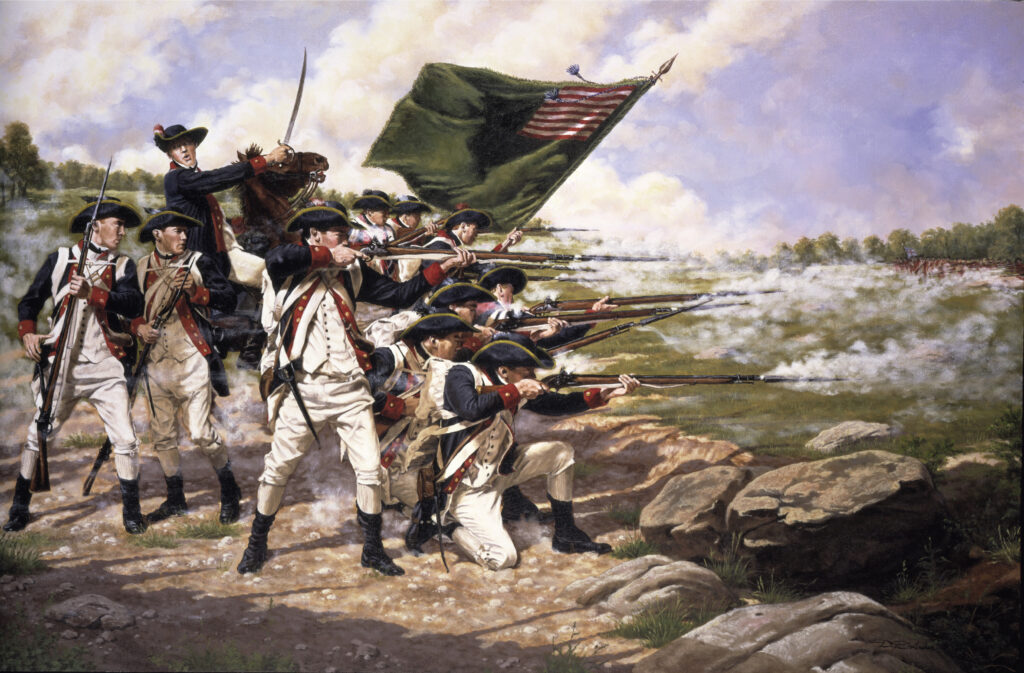
Those of us who write and speak on TACP history also emphasis our heritage. Running throughout our long history is a glorious heritage of courage in the face of danger, tenacity despite overwhelming odds and hardships, and ingenuity when others say the situation is hopeless. I have decided to offer up a series of vignettes putting our TACP heritage in a wider context of carrying on another precious national military heritage: that of the American fighting man. Just as we stand in a long line of TACP heroes whose standards we must uphold, so too we stand in a long line of American heroes, and we must remember that we carry on that heritage as well. From the very beginning of our country, generations of our countrymen have marveled at their warriors and asking, “Where does America keep finding such men?” That heritage will be the unifying feature of all these vignettes.
In this series I don’t intend to follow any particular pattern or historical timeline; I’ll exercise the author’s prerogative to write what I feel like writing. Besides, there are so many crackin’ good stories to choose from!
I would like to start with a couple of the many largely unknown units in the American Revolution. One theme I will emphasize in this series is that we aren’t the first who were “forgotten.” We grew up learning of the long odds and incredible suffering yet unimaginable successes of the Revolution as a whole, but have any of you ever heard much about Smallwood’s Maryland Militia, or Haslett’s Delaware Militia? While the stories of Baron von Steuben’s Continentals and the daring exploits of Francis Marion are somewhat better known, when placed beside these units – and note that both came from two of the smallest states – even today we can only shake our heads and marvel at these early examples of this other heritage we have inherited – the heritage of the American fighting man.
On 27 August, 1776, only weeks after the signing of the Declaration of Independence, the Battle of Long Island, or the Battle of Brooklyn as it is also known, was an unmitigated disaster. No one will exceed me in praise of George Washington; I would even argue that he, along with Abraham Lincoln, were the greatest Americans who ever lived. But… you have to admit that Washington was not the most consistent tactician. With plenty of time to prepare his battleline, George left his left flank hanging in mid-air. The British were dumb, but they weren’t stupid, and they quickly took full advantage of that golden opportunity.
The British commander ordered a textbook “pin and flank” maneuver and the American army was undone. The left flank collapsed like a cheap tent and panic spread rapidly as troops fled westward spreading panic down the line, but the British were closing in on them from the front as well in a classic pincer movement.
Practically every historian who has ever written about this battle agrees: Washington’s army was on the brink of total annihilation. It’s no exaggeration to say the Revolution could have ended that day. What prevented this and allowed the Continental Army to escape to fight another day? That story owes to Lord Stirling’s brigade, which was holding down the right flank.
Stirling himself was a colorful character. His real name was William Alexander, claimant to the
Scottish title of Earl of Stirling. Scotland’s parliament recognized his claim, but the British
parliament in London did not (remember: 1762, when the title was denied, was only 17 years
after the 1745 Scottish Rising, and the English were still in a vengeful mood.) Despite this petty
insult, Alexander styled himself Lord Stirling for the rest of his life; Washington and the other
leaders of the Continental Army honored his claim, if, for no other reason because, unlike other
leaders with English titles, Lord Stirling was, throughout the Revolution, one of Washington’s
ablest commanders. The bulk of Stirling’s brigade was made up of the 1st Delaware and 1st
Maryland regiments, better known at the time as Haslet’s Delaware militia and Smallwood’s
Marylanders. With his battle line collapsing, Washington, in what had to be a desperate last gasp
gesture, ordered Stirling to form a rear-guard to buy time for the Continentals to escape the
rapidly closing trap. To me, this was Sterling’s finest moment: as the brigade commander, he
could have ordered his Delaware and Maryland regiments to stand and then retire with the rest of
the brigade. Instead, he told them he’d stay right there with them and personally led the charges.
I think debates about the quality and character of officers and commanders are endemic to
warfare, but I’m sure you will agree that this episode, in and of itself, sets “Lord Stirling” among
the very best. In fact, he stayed with his men so long that he was captured by the British as his
men retired in good order. The British House of Lords may have denied his aristocratic claims,
but his actions truly marked him as noble.
What happened next is the stuff of legend. I’m sure you’ve heard stories of how unreliable
American militia units were during the Revolution; well, putting aside Lexington, Concord, and
Bunker Hill, all three of which were militia actions, Haslet’s Delaware militia and Smallwood’s
Marylanders were exceptions. In a later installment I’ll tell the story of how one sly American
fox turned that stereotype back on the British in a manner that is still studied in war colleges
around the world, but for this episode, I’ll just say the British were counting on this to seal the
fate of Washington’s army. There certainly were episodes throughout the Revolution that bore
out the British stereotype, but not today! Not only did the men of Delaware and Maryland hold
fast, they actually launched several bayonet charges of their own. The ferocity of the American
rear-guard action caught the British (and their Hessian hirelings) so off guard that they fell back
and the men of Delaware and Maryland actually captured upwards of two dozen Royal Marines
– then, as now, considered the cream of the British military.
The British regrouped, charged again, but the volume of fire generated by the Delaware and
Maryland regiments stopped them in their tracks – again. Not surprisingly, Stirling’s men took
tremendous casualties, but they held until ordered to retire. More importantly, they bought
precious time for Washington and his army to retreat to prepared fortifications on the Brooklyn
Heights. Which unit played the larger role or who gets credit for what matters not: the two badly
out-numbered regiments stood and made many a British and Hessian realize Americans could
fight, that they could stand in the face of British bayonet charges, and that they could launch
some very deadly charges of their own.
Having bought precious time, and seeing that further resistance was futile, Sterling ordered his
men to disperse and make their way back to friendly lines as best they could. For most, this
meant crossing a boggy creek while under fire, and for those who could not swim, it meant capture. By that point, Sterling himself was in an untenable position and was captured. Like the good Scotsman he was, though, he refused to surrender to the English; instead he handed over his sword to the Hessian commander. A few months later he was released under a prisoner exchange.
By the end of that heroic day, the men of Delaware and Maryland had paid a terrible price: together, the two units suffered 256 killed – over 60% of their numbers and one of the highest unit death toll percentages in American military history. The cost was high, but the time they bought for the Continental Army not only saved the army, it also saved the Revolution.
It truly is a shame that so few Americans remember the events of this day, but that’s a story TACPs are all too familiar with. In fact, by a strange twist of fate, what little is remembered by anyone who knows anything of these two courageous bands and one of history’s epic “last stands” honors primarily the Marylanders: to this day that state’s official nickname is “The Old Line State” because their militia men held the line on that day of immortal glory. The two units took so many casualties they were later joined and fought together throughout the war earning even more distinctions. Collectively that band came to be known by several nicknames: “The Maryland 400,” “The Bayonets of the Revolution,” and, my personal favorite, “Washington’s Immortals.” The “400” moniker came from a rough estimate of those who made the last stand, but it is a bit of a misnomer: the Maryland militia numbered somewhere close to 250, the Delaware militia roughly 150. As the National Park Service website says, “a more apt term should be the ‘Maryland and Delaware 400.’” These two units so consistently and prominently performed such exemplary service, battle after battle throughout the war, despite casualties, that their legacies became intertwined. Right through to the very end of the Revolution they were considered one of the most elite units of the Continental Army.
